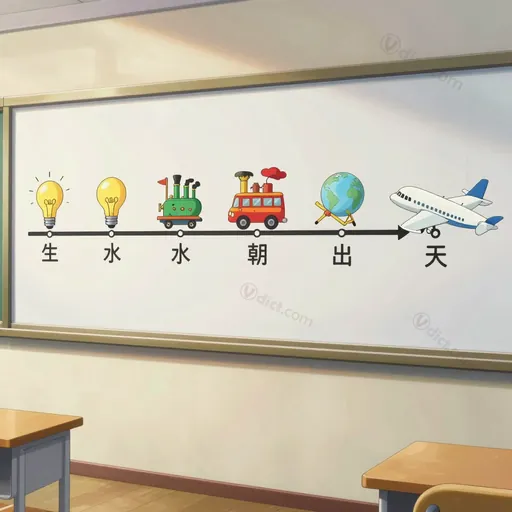
temporal order
Definition
Noun: * The sequential arrangement of events in time: The specific order in which events occur, from first to last, based on their position on a timeline. It describes the "when" of events relative to each other.
Usage
The term "temporal order" is used to discuss the sequence or chronology of events. It is a formal and academic term common in fields like history, physics, narrative analysis, and cognitive science. * It is often discussed in contrast to other types of order, such as logical order or spatial order. * Common verbs used with it include establish, determine, disrupt, perceive, and maintain.
Examples
- Historians work to establish the correct temporal order of battles in a war.
- The film used flashbacks, disrupting the linear temporal order of the story.
- Understanding cause and effect depends on perceiving the correct temporal order of actions.
- The experiment tested the infants' ability to recognize temporal order in a series of images.
Advanced Usage
- Temporal ordering: This phrase emphasizes the active process or principle of arranging things in time.
- The temporal ordering of geological layers is a fundamental principle of stratigraphy.
- In computing and data systems, "temporal order" refers to the sequence in which transactions or events are processed and recorded.
Variants and Related Words
- Chronology (n): The arrangement of events in the order of their occurrence in time; often implies a detailed list or study.
- Sequence (n): A particular order in which related events, movements, or things follow each other. (This is a more general term.)
- Temporal (adj): Relating to time as opposed to eternity or spiritual matters; or relating to secular life.
- Anachronism (n): Something placed in an incorrect historical or temporal order.
Synonyms
- Chronological order
- Time sequence
- Succession
- Timeline
Antonyms
- Random order
- Simultaneity
- Spatial order
Noun
-
arrangement of events in time
Khám phá thêm
Các từ liên quan
Từ đồng nghĩa
Từ gần giống